How to choose glass partition installers in London
This page is written to help you judge us against anyone else. It sets out the questions, documents and quotation details that separate a competent installer from a company that is about to subcontract your job.
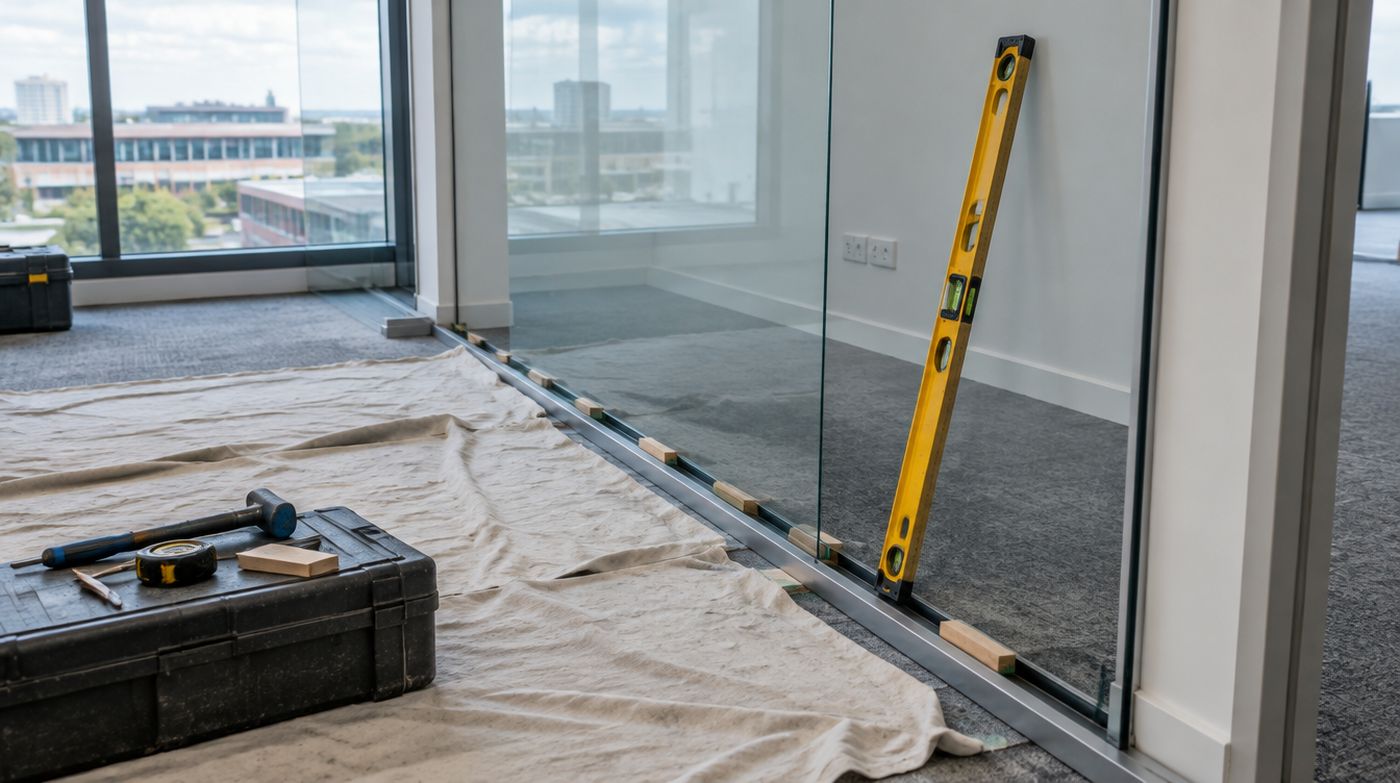
What a search for glass partition installers London will not tell you
Type glass partition installers London into a search engine and you get page after page of companies offering the same thing in the same words. What the results will not tell you is which of them cuts its own glass, which employs the fitters who turn up, which has ever worked in a managed building in the City, and which is a website in front of a subcontractor. The market is genuinely wide open: the same length of wall can be bought from a one-van operation, a fit-out contractor, a trade counter with a fitter on call, or a company that makes the glass itself. Prices differ by half and a one-page quotation will not show you why.
The questions that expose the difference between two quotations
Who fabricates the glass, and where? If the answer is a supplier, ask which one and what the lead time is for a remake. On a partition job the glass gets remade more often than anyone admits, because buildings are out of tolerance and toughened panes cannot be trimmed. The difference between a two-day remake and a three-week remake is the difference between a snag and a programme failure.
Who will be on site, and are they employed? Ask for names, and ask whether the fitters are the company’s own or a labour-only gang booked for the week. There is nothing dishonest about subcontracting, but it changes who is accountable when a panel is scratched or a track is drilled through a conduit, and it changes how easily you get someone back for a snag in month three.
Have you surveyed before pricing? Any quotation issued without someone standing on the floor with a laser is an estimate wearing a quotation’s clothes. Slab heights, floor levels, mullion centres and the state of the ceiling grid all move the price. A company that will not survey before quoting is either planning to re-price later or planning to absorb the risk by cutting something you cannot see.
What is excluded? This is the most useful question on the list, and the answer tells you more than the price. Making good the ceiling tiles and grid, moving sprinkler heads, electrical isolation, waste removal, out-of-hours working, hoist or lift bookings, protection of finished floors: every one of those either sits in the quote or lands on you.
The paperwork a competent installer has ready without being chased
On commercial sites in London you will be asked for most of this before anyone gets through the door, and a company that treats the request as an imposition has not worked much in managed buildings. Ask for it at tender stage, not the week before installation.
Public liability insurance, with a figure appropriate to the building. Many London landlords and managing agents set a minimum, often £5m or £10m for work in a let office building, and if an installer’s cover is below the building’s requirement they cannot work there at all. Employer’s liability insurance, which is a legal requirement for a company with employees and is also the quickest way to find out whether the fitters are actually employed. A method statement and risk assessment written for your building rather than a generic document with another client’s name still in the header. Evidence of competence for the work involved, which on a partition job usually means CSCS cards for the site, and PASMA or IPAF where tower scaffolds or powered access are used at height.
Then the things nobody asks for and should. Confirmation of how glass will be moved into the building and whether the goods lift can take the longest panel, which is a dimension and not an opinion. A waste transfer arrangement, because old partitions and glass offcuts are commercial waste and have to leave the building legally. And an O&M or handover file at the end, listing glass make-ups, hardware schedules and finish references, which is the document that makes a replacement pane in two years a phone call rather than an investigation.
Worth knowing: FENSA registration, which we hold, is a competent person scheme for replacement windows and doors in dwellings. It is a genuine credential and it is the right question to ask if someone is replacing the glazing in your flat. It is not the relevant credential for internal commercial partitions, and any installer leaning on a scheme logo instead of answering a question about your building should be asked the question again.
How to read a glass partition quotation and spot what is missing
A single lump sum with the words “supply and install glass partitions as discussed” is not a quotation, it is a promise. What you want is a panel schedule: every pane listed with its size, thickness, whether it is toughened or laminated, and its edgework. Every door listed with its leaf make-up and its hardware item by item. The head detail and the floor track named. The frame finish given as a coating standard and a colour reference.
With that in hand, two quotations become comparable, and the cheaper one usually reveals itself in one of five places. A shallower head channel with no deflection allowance. Ground edges where polished edges were implied. A surface-mounted overhead closer instead of a floor spring or concealed transom closer. A thinner pane in the tall panels. Or manifestation priced as two frosted bands when the drawing showed a designed pattern.
Check the payment terms as hard as you check the price. A deposit to cover materials on a made-to-measure product is normal and reasonable. A demand for most of the contract value before anything is manufactured is not, and on a job of any size the sensible shape is a materials deposit, a payment on delivery to site or on completion of installation, and a retention until snags are cleared. If a company will not accept a small retention against snagging, ask yourself what they expect the snag list to look like.
Warning signs in the first phone call and the first visit
A price given over the phone for a floor nobody has seen. A surveyor who does not ask what happens in each room, which is how you end up with a boardroom in single glazing and a tea point in acoustic laminate. No questions about the ceiling or the floor construction, which are the two things that dictate how the partition is fixed. No interest in the building’s access arrangements, loading bay, lift dimensions or permitted working hours in a city where all four of those can stop a delivery.
Then the specific ones. Any installer who describes a screen as “fire rated” without producing the test evidence and the specific system reference should be ruled out on the spot: fire-resisting glazed screens are tested as complete systems, glass, frame, seals and all, and the certification applies to that system and not to the components. Anyone who says a toughened pane can be drilled on site for a handle is wrong, and worth knowing about before they try it. And anyone who tells you that an acoustic glass partition will make a room soundproof is either overselling or does not understand their own product.
Checking access, permits and working hours before anyone prices it
London is where partition jobs go wrong for reasons that have nothing to do with glass. A 2.8 metre pane has to physically arrive on the floor, and in a Victorian conversion in Clerkenwell or a mansion block office in Marylebone that can mean a stair turn it will not pass. Measure the route, not the room. In the City and the West End, loading bays are booked in slots, deliveries are often restricted to early mornings, and a van sitting on a red route is an immediate penalty and a lost morning.
Managed buildings add another layer: permits to work, induction, out-of-hours access for any drilling or noisy work, protection of lift cars and common parts, and a building manager who has to sign everything off. Ask a prospective installer who obtains those permits and whether the time taken to get them is in their programme. We do this routinely across the inner boroughs, and the honest answer is that in a managed building the permit process is often the longest item on the programme and not the installation.
References you can actually check, and warranties worth having
Ask for two references where the work resembles yours in size and building type, and ask to speak to the person who managed the job rather than read a line on a website. A company that has done the work will produce them. Then ask a better question than “were you happy”: ask whether anything had to be remade, how long it took, and how the company behaved when it happened. Every installer has a remake. The useful information is what they did about it.
On warranty, read what is actually covered. Glass breakage after handover is almost never covered by anyone, and should not be, because glass breaks through impact. What should be covered is workmanship, hardware, the integrity of a sealed double glazed unit and the finish on the metalwork, and the practical value of the cover depends entirely on whether the company still exists and still holds your panel schedule. That is the quiet argument for using an installer that makes its own glass: the replacement comes from the same workshop, cut to the original dimension, in the same finish.
We fabricate at 6 Atlas Road in Wembley and install with our own teams across Greater London, strongest in the north, west and central boroughs. We survey free, quote in writing with a panel schedule, and we are content to be checked against every question on this page. If a competitor answers them better, use them. Call 020 4634 6045, Monday to Friday, 8am to 5pm.
FAQ
Questions about glass partition installers london
What should I ask a glass partition installer before accepting a quote?
Five questions. Who fabricates the glass and what is the lead time for a remake, because toughened panes cannot be altered and remakes happen on most jobs. Who will be on site and are they employed by the company or a labour-only gang. Have they surveyed the floor with a laser before pricing, rather than working from a drawing. What is specifically excluded, naming ceiling and floor making good, sprinkler and electrical alterations, waste removal and out-of-hours working. And what the head detail is, since a head with no allowance for structural deflection is the single most common hidden saving in a cheap quotation.
Do glass partition installers need to be FENSA registered?
No. FENSA is a competent person scheme covering replacement windows and doors in dwellings, assessed against the building regulations that apply to domestic glazing work. It is a real and useful credential, and it is the right thing to ask about if someone is replacing the glazing in your home. It has no bearing on internal commercial partitions, which are not notifiable work of that kind. For a partition job the relevant checks are insurance at the level your building requires, employer’s liability, a site-specific method statement and risk assessment, competence cards for the work and any work at height, and evidence of the glass standards being supplied.
What insurance should a glass partition installer have in London?
Public liability cover at least equal to whatever the building requires, which in a let London office is commonly a £5m or £10m minimum set by the landlord or managing agent. If the installer’s cover is lower than the building’s threshold they will not be permitted on site, so check this before tendering rather than the week before installation. Employer’s liability insurance is a legal requirement for any company with employees, and asking for it also reveals whether the fitters are genuinely employed or booked in as self-employed labour. Ask for current certificates, not a statement that cover exists.
Get a fixed price for your partition project
Tell us the floor and what you need to separate. We will survey across London, usually within 48 hours, and quote in writing.