Glass partitions are all we fit
We are a London glazing company with our own workshop. That changes how a partition job runs.
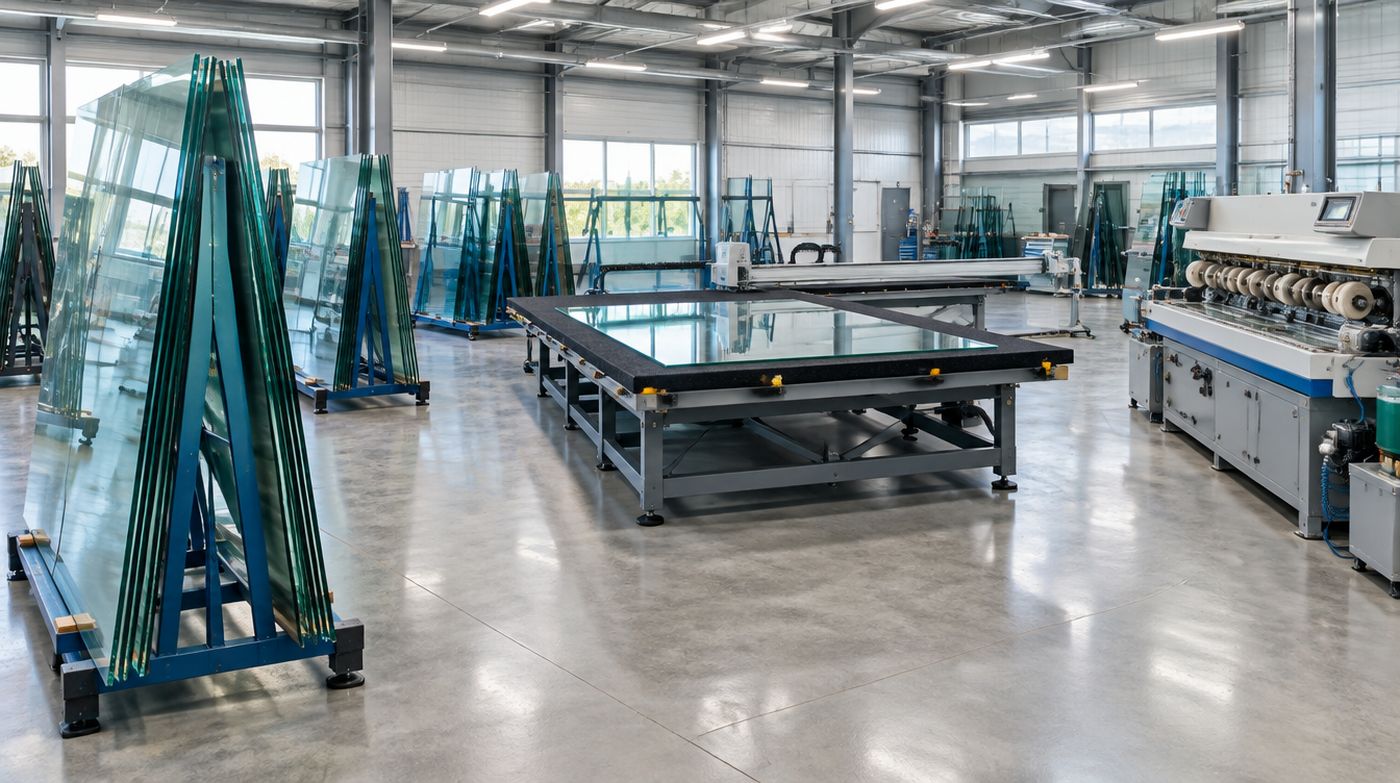
We make the glass we install
Most companies selling glass partitions in London are installers who buy processed glass in. We are a glass company that installs. Our workshop at 6 Atlas Road in Wembley cuts, edges, polishes, drills and notches glass, toughens it, laminates it and makes up sealed double glazed units. The panes that go into your office are made by us.
That matters in practical ways rather than sentimental ones. When a pane is damaged on site, we re-make it in our own furnace rather than joining the back of a supplier’s order book. When a dimension needs checking against what is physically possible, the person who answers is the person who will cut it. And when we tell you that reducing a pane height by 200mm will save you money, it is because we know the sheet size, the cutting yield and the processing time behind that number, not because we are guessing at a rate card.
It also keeps us honest about lead times. We know what is in the workshop and what the toughening queue looks like, so the date we give you is a date we control.
Our own installation teams, not subcontractors
We employ our installers. The same company surveys the job, makes the glass and glazes it, and the fitter on site can pick up the phone to the person who cut the pane.
The reason we say this plainly is that subcontracting is the norm in this trade and it causes specific, predictable failures. The surveyor never meets the fitter, so site knowledge is lost between the drawing and the day. Subcontract gangs are usually paid per job, which rewards speed, and the places speed shows are silicone joints, edge clearances and door adjustment. And when something goes wrong six months later, the sales company and the installer each explain that it is the other one’s problem. As glass partition installers in London we would rather not have that conversation available to us.
How a job runs from first call to handover
- Tell us what you have. A floor plan, even a sketch with dimensions on it, saves a week of back and forth. A photograph of the ceiling and the floor is worth more than you would think.
- We give you a budget range on the phone. Not a fixed price. Enough to know whether the project is viable before anybody spends an afternoon.
- Free site survey anywhere in London. We survey the glazing, the building and the access route in the same visit.
- Written fixed quotation, with the glass specification pane by pane, the head and base detail, the hardware schedule, the manifestation allowance and an explicit list of exclusions.
- Setting-out drawing and glass schedule for your approval. Changes after approval cost real money, so we ask you to walk the line on site with the drawing in your hand.
- Manufacture in Wembley. Clear single glazing is quick. Double glazed units, integral blinds, acid-etched finishes and specialist laminates take longer and we will tell you how much longer before you order.
- Installation to your building’s hours, permits and induction requirements.
- Snagging walk round with you, door and floor spring adjustment, and a handover file.
Standards and paperwork we work to
We are a FENSA registered installer. On commercial glass partitions the standards that actually bite are these, and we will put the relevant ones on your quotation rather than leaving you to ask.
- Toughened glass to BS EN 12150 and laminated glass to BS EN 14449, supplied with the permanent marking those standards require. If a pane in your office has no mark, somebody has questions to answer.
- Safety glass to BS 6206 Class A in critical locations, which is what a full-height office screen is.
- Approved Document K for critical locations and for glazing in a position where people can walk into it, which drives both the glass specification and what has to appear on the face of the pane.
- BS 6180 where a glazed screen is also doing the job of a barrier, at a mezzanine edge, a stair or a level change. A barrier is a different structural calculation to a partition, and if a drawing has quietly asked for one we will say so rather than quote it as ordinary glazing.
- Approved Document L where an internal screen forms part of a thermal line, which is unusual inside an office but does come up at atria, unheated cores and semi-external lobbies.
- Approved Document M for door opening forces, handle heights, visual contrast and clear opening widths where accessibility is in scope.
On the paperwork side you get a method statement and risk assessment for the installation, our public liability certificate, waste transfer documentation where we strip out an old layout, and a handover file with the glass schedule, the hardware specification and the cleaning and maintenance notes. The glass schedule is the one to keep: it is what makes a future breakage a phone call rather than a re-survey.
What we will tell you that other companies will not
We are not always the cheapest quote and we do not pretend otherwise. What we offer instead is a straight answer, including when the straight answer loses us money.
- When a framed system is the better buy. Frameless glass partitions photograph beautifully. Framed aluminium is more forgiving in an out-of-square building, cheaper to reconfigure, and the right call for a tenant who will move again before the lease ends.
- When you do not need acoustic glass. If the voids above and below the line are shared, a double glazed acoustic specification will not deliver what the brochure figure suggests, and we would rather you spent that budget on the ceiling.
- When the answer is not glass. Solid walls hold fixings, block sound and cost less. Plenty of offices need both, in the right places.
- When a competing quote is too low. Send it to us and we will read the exclusions with you and point at the gaps. Sometimes the cheap quote is genuinely cheap and we will tell you to take it.
What we do not take on
- Fire-rated screens inside a standard partition package. We quote them separately against a tested system with documentation, because a fire-resisting assembly is only as good as the certificate behind the exact combination of parts.
- Fixed prices without a survey. We will give you a budget range from a plan so you can plan, but a floor plan never describes what a building is actually doing, and a fixed price from one is a dispute waiting to happen.
- Specifications we think will fail. If a drawing asks for an acoustic rating the detail cannot achieve, or a pane size the lift cannot take, we will say what we would do instead and let you decide. We will not quote it and hope.
- Façade work. Curtain walling, shopfronts to the weather line and structural glazing on the outside of a building are somebody else’s speciality. Internal partitions, screens and glass office doors are ours.
Working with architects, project managers and fit-out contractors
A good share of our work comes through fit-out contractors, designers and project managers rather than direct from the occupier, and that is a different relationship with different obligations. We quote against your drawings and your specification, we attend design team meetings where it helps, and we issue our setting-out as a drawing your other trades can work to rather than a measurement kept in our heads.
What we need from you is the interfaces. Where the ceiling grid is being set out from, what the floor build-up will be at the time we glaze, whether the sprinkler drops are moving, who is making good the ceiling where we cut it, what the builder’s work requirements are at our abutments, and whether anybody has asked for an acoustic rating in writing. Those seven items cause almost every variation on a glazing package.
What you get from us is a package that does not drift. We will tell you at tender stage if a detail on the drawing cannot be built, rather than winning the job and raising it as a variation later. We will give you a realistic processing lead time for the actual specification, not the optimistic one, and we will hold a programme slot rather than sell it twice. If your programme slips, as programmes do, we would rather re-sequence with you than sit panes in your corridor for a fortnight collecting edge damage.
Guarantees and what a guarantee is actually worth
Our workmanship and the glass we manufacture are guaranteed, and the terms go on the quotation in writing before you order, because a guarantee you have not read is a marketing line. What matters more than the length of it is who is standing behind it. A guarantee from a sales company that subcontracted the installation and bought the glass in from a third party involves three parties and a lot of pointing. Ours involves one.
It is also worth being clear about what any guarantee in this trade does not cover: impact damage, panes broken by furniture or cleaning equipment, hardware abused past its cycle rating, and film damaged by the wrong cleaning products. We will tell you how to clean etched glass and applied film properly at handover, because the usual cause of tired-looking manifestation after two years is a cleaning contractor with a scouring pad and good intentions.
Supply only, for fit-out contractors and shopfitters
If you have your own installation teams, you can buy processed glass from the workshop. We cut, polish, notch, drill, toughen and laminate to your schedule, make up double glazed units, and we will check your schedule before we run it. We would far rather query an odd dimension on a Monday than deliver forty panes made perfectly to a mistake. Collection from Wembley or delivery across London on our own vehicles with proper glass frames.
Aftercare, spares and breakages
We keep the glass schedule for every job, so a broken pane is a telephone call and a re-make rather than another survey and another argument about who measured what.
Two things worth knowing about toughened glass in a working office. It can fail weeks or months after installation, and when it does the cause is nearly always edge damage, an over-tightened fixing or a pane bearing directly on something hard. That is why edge clearance, correct setting blocks and proper packing matter at install, and why a fitter who is being paid to be quick is a false economy. Secondly, doors move. Floor springs settle, buildings shift and seasonal movement changes a closing arc. We come back and adjust them.
How to get hold of us
Telephone 020 4634 6045, Monday to Friday, 8am to 5pm. The workshop is at 6 Atlas Road, Wembley, London HA9 0JH. Installations outside normal hours, including evenings and weekends in occupied offices, are arranged as part of the quotation. We cover Greater London and are strongest in north, west and central London, and if a job is better suited to somebody closer to it we will say that too.
Get a fixed price for your partition project
Tell us the floor and what you need to separate. We will survey across London, usually within 48 hours, and quote in writing.